Identify both sides of the comparison
A margin describes room between an expected demand and a relevant limit. Before interpreting that room, establish what each quantity means, how it was obtained, and whether both refer to the same conditions.
A limit might concern a particular failure mode. Demand might be a predicted load rather than a measured one. A reassuring comparison can become misleading if either side is detached from its assumptions.
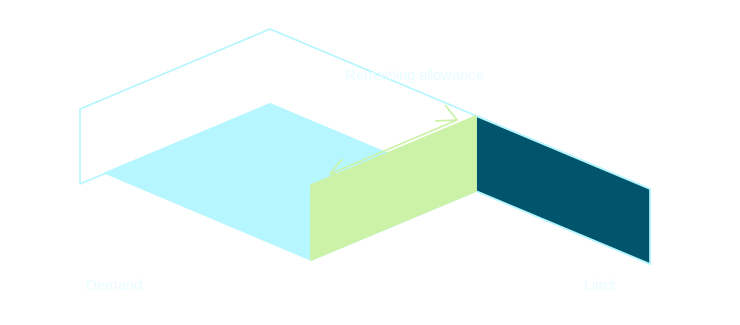
Hypothetical arithmetic
A ratio with a boundary
Suppose a simplified model uses a limiting load of 120 units and a demand of 80 units. The limit-to-demand ratio is 1.5. The numerical difference is 40 units. These are two descriptions of the same assumed comparison, expressed in different ways.
Neither value establishes that a real object is suitable for use. The example leaves out material variation, wear, changing loads, and other failure modes. It is an arithmetic illustration, not a recommendation for a design factor.
Read the assumptions with the number
In a simple linear stress comparison, a factor of safety can be expressed as a limiting strength divided by a predicted stress. That formulation has a defined scope. A different behavior or analysis method may require a different interpretation.
Extra allowance also has consequences. Increasing a dimension could add mass or alter fit. Reducing demand might change the intended function. The size of a gap cannot resolve those tradeoffs by itself.
When reading a reported margin, ask which limit controls, which operating condition creates the demand, and what uncertainty remains. A number becomes useful when those questions have visible answers. Real design decisions require appropriate methods and qualified assessment for the application.
Definition reference: Ansys Mechanical glossary: factor of safety.